Demonizing Antifa: Federal Prosecutions Target Radical Organizers [ThreeWayFight]
By Matthew N. Lyons
With the court cases against the Prairieland ICE protesters and the Minnesota 15, the Trump administration has ratcheted up its authoritarian power drive. The regime is trying to criminalize radical politics and grassroots organizing, as a cornerstone of its campaign to suppress all political dissent.
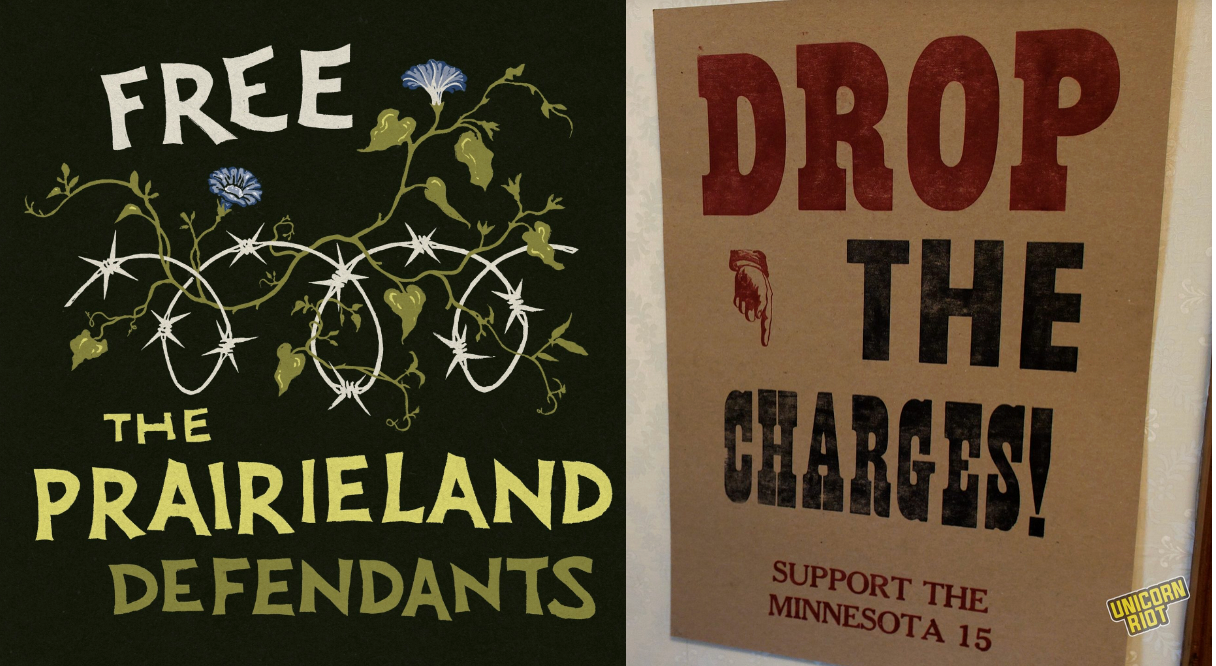
In the Prairieland case, a federal judge slapped extraordinarily harsh sentences—ranging from 30 to 100 years—on eight defendants connected with a July 4, 2025 demonstration at the Prairieland Detention Facility in Alvarado, Texas. Benjamin Song, who was convicted of attempted murder for shooting a police officer in the shoulder after the officer drew his weapon, received 100 years. Eight of the nine were convicted of “providing material support to terrorists” for acts such as owning a printer used to make pamphlets and being part of a leftist book club. One defendant, who wasn’t even at the July 4th protest, got 30 years for “concealing” documents—i.e., transporting a box of zines. (Eight days later, an additional seven Prairieland defendants, most of whom had pleaded guilty, received sentences ranging from 2 to 50 years.)
The Minnesota 15, meanwhile, are fifteen organizers charged with federal conspiracy and other crimes for participating in the community defense against Operation Metro Surge, ICE and Border Protection’s campaign of mass roundups, physical attacks, and murder in the Twin Cities and beyond this past winter. According to the June 2026 indictment, the alleged conspiracy aimed at “preventing the enforcement of federal immigration law by force, intimidation, and threats” and, more simply, “opposing the authority of the United States government.” None of the Minnesota defendants are accused of injuring officers; most of the acts cited as evidence of their complicity include things like attending protests and meetings, posting to social media, and wearing clothes with political messages.
These and other prosecutions of radical organizers (such as the Spokane 3, convicted of conspiracy for a June 2025 anti-ICE protest) have been fueled by President Trump’s particular take on anti-radicalism, in which the spectre of “antifa” takes on demonic features with little or no connection to the realities of militant antifascism. Scapegoating leftists has been integral to Trump’s message for years, but it got a big boost following the September 2025 assassination of Charlie Kirk, which Trump and other right-wingers immediately blamed (without evidence) on the radical left. In a special TV tribute hosted by Vice President Vance a few days after Kirk’s death, presidential advisor Stephen Miller declared that the federal government would “use every resource…to identify, disrupt, dismantle, and destroy” the “terrorist networks” that supposedly brought about Kirk’s killing. Soon after, Trump signed an executive order designating antifa as a “domestic terrorist organization”—even though it’s not even an organization—and instructed federal agencies to “investigate, prosecute, and disrupt” protesters engaging in “anti-capitalism,” “anti-fascism,” and “anti-Americanism.”
The demonization of antifa is an example of countersubversion ideology—a form of conspiracism that portrays enemies secretly plotting not to oppress society, but to subvert it. In the United States from the colonial period through the 19th century, countersubversion ideology was embodied in fears of slave revolts, emancipated African Americans, and radical labor organizers. Countersubversion ideology infused the Red Scares that followed World War I and World War II, the two intervals in the 20th century when federal anti-leftist repression was most intense.
The Trump regime’s campaign against antifa echoes the 20th-century Red Scares, and it also builds on several decades of gradually expanding state repression, which both Republican and Democratic administrations have pushed forward. George W. Bush gave us the USA Patriot Act and the Department of Homeland Security, but Barack Obama dramatically expanded the surveillance state, and Joe Biden’s administration prosecuted January 6 defendants with new and expansive conceptions of criminal conspiracy that helped pave the way for what the Trump regime’s prosecutors are doing now.
Trump’s repression goes far beyond criminal prosecutions. The regime has kidnapped, imprisoned, and deported hundreds of thousands of people under its anti-immigrant policy. It has used an array of administrative levers, such as investigations, regulatory threats, and withholding allocated funds, to bludgeon political critics. Trump and other top officials have also vilified opponents as evil, insane, traitorous, or subhuman—and this rhetoric has inspired vigilante attacks.
And unlike the 20th century Red Scares, Trump’s repression supports a far-reaching effort to transform the federal government along dictatorial lines. The regime has been reshaping ICE and Border Protection into secret police forces that seek to operate with little or no legal constraints, dismantling or restructuring large sections of the federal bureaucracy to suit its political whims, and concentrating unprecedented power in the presidency.
The Trump regime’s drive toward dictatorship is far from complete and far from inevitable, but it’s already made substantial structural changes that won’t be undone just by switching presidents or parties in power. Over the past several decades, Democrats have preserved or extended most Republican-led repressive measures, and we should expect this to happen again if the Democrats return to power and are left to their own devices. Whichever of the two major parties is in charge, dismantling state repression will require sustained mass-based resistance.
At the same time, the drive toward dictatorship isn’t a sign of strength; it’s a sign of weakness. On a subjective level, it reflects Trump’s profound personal insecurity; on a structural level, it reflects a dysfunctional political system, a state that has lost much of its popular legitimacy, and a ruling class that is fragmented and lacks a cohesive strategic direction. Even Trump’s own coalition is deeply fractured. These weaknesses mean opportunities for mass-based opposition and radical organizing based on liberatory principles.
The crackdown against “antifa” has picked up steam because grassroots resistance to the regime has spread and become more effective. Mass community defense in Minnesota didn’t end anti-immigrant kidnappings, but it forced the regime to end Operation Metro Surge and dramatically reduce the number of ICE agents in the state. Prosecution of the Minnesota 15 is payback for this defeat.
With the Prairieland defendants, Minnesota 15, and others hit by the Trump regime’s anti-radical crackdown, we need to defend those targeted despite political differences, to practice “non-sectarian defense of other anti-fascists,” as Anti-Racist Action inscribed in its Points of Unity 30 years ago. To this end, some organizations have issued statements of solidarity, as for example the National Lawyers Guild did with the Prairieland defendants and National Nurses United did with the Minnesota 15.
I’ll close with a social media statement from one of the Minnesota 15 defendants:
“Through all my years as an activist I’ve always said that the best safety is having a community around you that cares what happens to you. That’s why my codefendants and I are going to keep raising hell, keep talk[ing] about this, and keep standing with our community as it faces attacks by a regime bent on revenge for our city’s legacy of resistance. My codefendants and I are not and never have been some clandestine ‘cell.’ What we have done, we have done in the broad light of day, in full view of our neighbors, coworkers, and friends. We are not ashamed, and I am personally honored to have such hot and brave comrades as I am blessed with.”
Ways to Help:
Support the Prairieland Defendants (DFW Support Committee)
Legal Defense Fund for the Minnesota 15 Anti-ICE Organizers
Support the Spokane 3 (Peace and Justice Action League of Spokane)
Image credits:
Prairieland Defendants poster courtesy of the DFW Support Committee.
Minnesota 15 poster image courtesy of Unicorn Riot, CC BY-SA 3.0.
Leave a Reply